Target Audience Questionnaire
- shiraavidan77
- Feb 5, 2023
- 8 min read
Updated: Mar 30, 2023
When creating any media product, it is necessary to be aware of the composition and characteristics of your potential customers. This could be done by conducting audience research to determine your magazine's target audience. To determine the target audience of our magazine, my class and I created a digital survey to discover our respondents' demographics and psychographics, preparing us for later on when we will have to design our magazine in accordance with our target audience. With this in mind, I created a 17-question survey on Google Forms, in which I collected 30 responses from my friends, family, and classmates on platforms such as Messages, Gmail, WhatsApp, and a QR code.
Survey Questions
What age group do you belong to?
What is your gender?
What ethnic group do you belong to?
How do you usually read magazines?
Which magazine genre are you most likely to buy?
On a scale of 1-5, with 5 being enjoy very much and 1 being do not enjoy, how much do you/would enjoy reading food magazines?
How much are you willing to spend on a food magazine?
What kind of content would you want to see the most in a food magazine?
Do you like or would like to read about Asian cuisine?
Do you eat Asian cuisine often?
Would you consider Asian cuisine as your favorite cuisine?
Are you open to trying new foods?
Are you willing to dine at expensive restaurants or splurge on costly food?
Do you enjoy cooking or baking?
Would any featured prizes or gifts encourage you to buy a magazine?
After observing the two images below, which magazine are you most likely to purchase?
Choose the sentence that applies to you the most.
Sending Out Survey
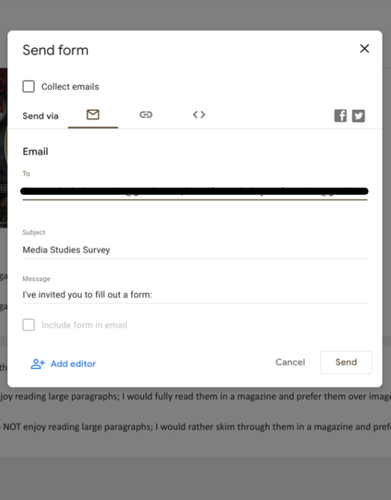
As previously mentioned, through Whatsapp, Messages, Gmail, and a QR code, I sent out my survey to a wide range of people, providing myself with a wide range of opinions that will help when designing my magazine. Some of these people included students at my school, friends, and family members.




Results
QUESTIONS 1-3: The following three questions helped me specifically identify my target audience's demographics, more specifically their age range, gender, and ethnic background.

Although food magazines usually target middle-aged cooks and stay-at-home moms looking for recipes, my survey indicated that most respondents were 15-17 (60%). However, as there were still smaller percentages of older age groups, I will most likely aim to have a more flexible target audience and produce content that targets several age groups.

Surprisingly, more than half (70%) of the respondents were female, persuading me to mainly target my magazine towards females. After all, this data may signify that women will be more intrigued by my food magazine than men.

As certain ethnicities may consume or prefer different cuisines of food, it is important for me to consider the respondents' ethnicities when determining my target audience. In this case, about half (53.3%) of the respondents were white, possibly meaning they may not be as familiar with the product displayed in my magazine (Asian food). Therefore, they may be more persuaded to read my magazine and, in this case, learn more about another cuisine.
QUESTIONS 4-5: The following two questions are more general and help me identify my target audience's preferences regarding where they like to read magazines and which magazine genre they are most likely to purchase. In turn, I would be able to understand whether or not the location of where my food magazine will be published and if its genre is an appropriate choice.

By observing the pie chart to the left, it is evident that half of my respondents don't read magazines, leading me to think that if such a large group of people doesn't read magazines, they possibly won't be interested in reading mine. Yet, about a quarter of people (23.3%) voted that they read magazines online, meaning they will possibly enjoy reading my magazine, which is also online.

Essentially, this graph displays and proves the idea that my respondents are interested in a wide variety of different magazine genres. In this case, tying with 20%, "Cooking, Food, and Beverage," "Science and Nature," as well as "Fashion and Style" were the top three genres that people favored. Overall, since only 20% voted for my genre, it is clear that most respondents (80%) may not be interested in reading a food magazine and would rather read about other genres.
QUESTIONS 6-8: The following three questions are more specific to my genre and specify the following: whether or not my target audience will be willing to read a magazine from my genre, how much they are willing to spend, and what content they would be most intrigued by. As a result, I would be able to choose an appropriate price and structure my magazine content-wise according to my target audience's interests and values (psychographics).

I used this question to determine the percentage of my target audience that would/do enjoy reading food magazines, and in turn, would be willing to read my own. Assuming that voting either a 3 or higher is considered liking food magazines, exactly 76.6% (a large percentage) like them and are most likely to read my magazine!
QUESTION 7!!
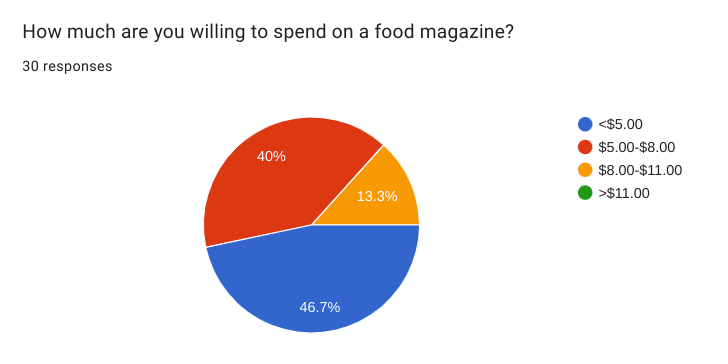
As made evident in the graph, most respondents wouldn't want to spend much on a food magazine; besides the 13.3%, 86.7% would not want to spend more than $8.00. 46.7% don't even want to spend more than $5.00, leading me to believe that the original price I wrote on my magazine cover sketch ($10.99) is too high! Instead, I am now considering changing the price to $7.99 to make it more affordable for my target audience.

After observing the results, I can conclude that gourmet recipes and cooking tips and tricks were the respondents' two top favorite types of content that they would like to see in my magazine. I will consider these two ideas when designing my table of contents and ensure they will be included the most. However, as it appears that all of the five choices were liked by all, I will most likely include a mix of all different types of content to appeal to a mix of readers.
QUESTIONS 9-11: The following three questions relate to my magazine's product (Asian food) by asking the respondents whether or not they would like to be educated about Asian cuisine, how often they eat it, and whether or not they would consider it their favorite cuisine. Therefore, it signifies who is truly interested in what my magazine has to offer.

By asking my target audience if they like/would like to read about Asian cuisine, it demonstrates who would be interested in reading my magazine. In fact, my magazine is most likely not the right pick for the 16.7% that voted "no."

I included this question to determine how many people are interested in my magazine's topic. More specifically, as a vast majority (88.3%) voted that they do eat Asian cuisine often, it signifies that these people have an interest in Asian cuisine (what my magazine is all about).

This question is similar to the two questions above; it further signifies my target audience's psychographics, leading me to conclude who would want to read my magazine. In this case, as 40% of people voted that Asian cuisine was not their favorite cuisine, it could signify that they would rather read about another culture's food. However, more than half of the respondents (60%) voted the opposite, meaning they would definitely be interested in my magazine!
QUESTIONS 12-14: The following three questions are also related to my target audience's psychographics: in this case, it deals with how adventurous they are with trying new foods, whether or not they are willing to spend a large amount of money on food, and whether or not they enjoy making their own food instead of dining out.

Surprisingly, every respondent voted in favor of being open to trying new foods, meaning that my target audience consists of individuals that enjoy trying unfamiliar, exotic dishes. Consequently, these people could possibly be classified into the fun/attics psychographic group (aspirational, fun-seeking active young people).
QUESTION 13!!

As a large number of participants (73.3%) are willing to dine at expensive restaurants, I am convinced to showcase more gourmet, luxury restaurants.

This question simply helps me decide what to include in my magazine based on my target audience's interests: since the majority of people (80%) are clearly interested in cooking or baking, I should ensure to include a large number of recipes in my table of contents.
QUESTIONS 15-17: The following three questions ask for my target audience's opinion on certain magazine elements and their preference in certain layouts, allowing me to possibly alter my original magazine cover sketch to appeal to a larger audience.

As 80% of my target audience believe that a featured prize or gift will encourage them to buy my magazine, I will definitely include one in my final magazine. In fact, these people are most likely to feel more satisfied in buying a magazine with the potential of winning something for free. After all, it may also make them feel as if they are truly getting their money's worth.

I used this question to determine which magazine layout my target audience is most intrigued by. More specifically, the image on the left is more minimalistic, relying more on photography rather than text: the cover lines are small and hard to read, while the main image is larger than any other element on the page. On the other hand, the image on the right is more crowded and contains larger and more coverlines, somewhat prioritizing text over photography. However, the results were relatively close to each other, so I will most likely design my magazine that combines elements from both images (not too blank and not too crowded).

I used this question to determine whether or not my target audience would enjoy reading large amounts of information throughout my magazine. An overwhelming majority (83.3%) voted in favor of not reading large paragraphs, hence why I will design my featured article with more images rather than text. Making my magazine more enjoyable and easier to follow along, this choice will accommodate a larger audience.
Conclusion

After analyzing the results from my survey and comparing them to my original target audience profile, I can conclude the following:
• My target audience mainly consists of mid-teens, but I will design my magazine to accommodate adults as well (similar to my original target audience profile).
• My target audience predominantly consists of females, unlike my original prediction in which I thought it would be neutral (females and males).
• My target audience consists of people arising from a variety of ethnicities (although a majority are white).
• My target audience mainly doesn't read magazines but would enjoy ones from various genres.
• My target audience enjoys food magazines to some extent, is not willing to spend much on one when purchasing, and primarily enjoys content that could be replicated at home (gourmet recipes and cooking tips and tricks).
• My target audience is interested in Asian cuisine: most would enjoy reading or learning about it, eat it often, and even consider it as their favorite cuisine.
• My target audience is adventurous in terms of food, is willing to splurge, and enjoys cooking at home (as expected).
• My target audience enjoys receiving gifts but does not enjoy reading large amounts of information at once.
With this in mind, there are a few demographics and psychographics that I should reconsider for my target audience, one being that I should possibly design my magazine to attract more females than males (rather than both). Plus, I may make my magazine more teen-friendly, including elements they are easily attracted to, such as puffs. In my original cover sketch, I did not include a puff, but I will now consider it for my final cover.
When observing the results from the survey, I was surprised by questions 7 and 13—two questions that dealt with price and signified that my target audience is cautious with their budget and spends money wisely. In fact, question 7 proved that people aren't willing to spend much on a food magazine:
46.7% would not want to spend more than $5.00
40% would not want to spend more than $8.00
Therefore, 86.7% would not be satisfied with my original price of $10.99!!
However, what truly surprised me was that later on in question 13, 73.3% stated that they were willing to dine at expensive restaurants or splurge on costly food. In other words, my target audience—especially the respondents that aren't interested in reading food magazines—would rather spend money on items they truly care about or think is necessary (in this case, the actual food rather than the magazine).


Comments